
Imagine you did everything right as a federal employee.
You saved well, built up your TSP, earned your FERS pension, and retired with a solid plan. For the first few years, everything feels like it worked.
You travel. You spend more time with family. You finally enjoy the life you spent decades building.
Then one day, you slip and injure yourself.
At first, it does not feel like a long-term care issue. It feels like recovery. A few doctor visits. Some physical therapy. Maybe your spouse helping a little more around the house.
But recovery takes longer than expected.
Now stairs are harder. Cooking is harder. Driving is painful. Your spouse wants to help, but cannot do everything. And by the time you finally call it “long-term care,” your retirement plan may already be under attack.
That is why long-term care is one of the biggest retirement risks federal retirees cannot afford to ignore.
It is not just a healthcare problem. It is not just an insurance problem. It is a retirement income problem, a family burden problem, and one of the few expenses that can attack a plan from every direction at once.
Why Long-Term Care Is the “Retirement Torpedo”
When federal employees think about retirement risk, they usually think about the obvious ones.
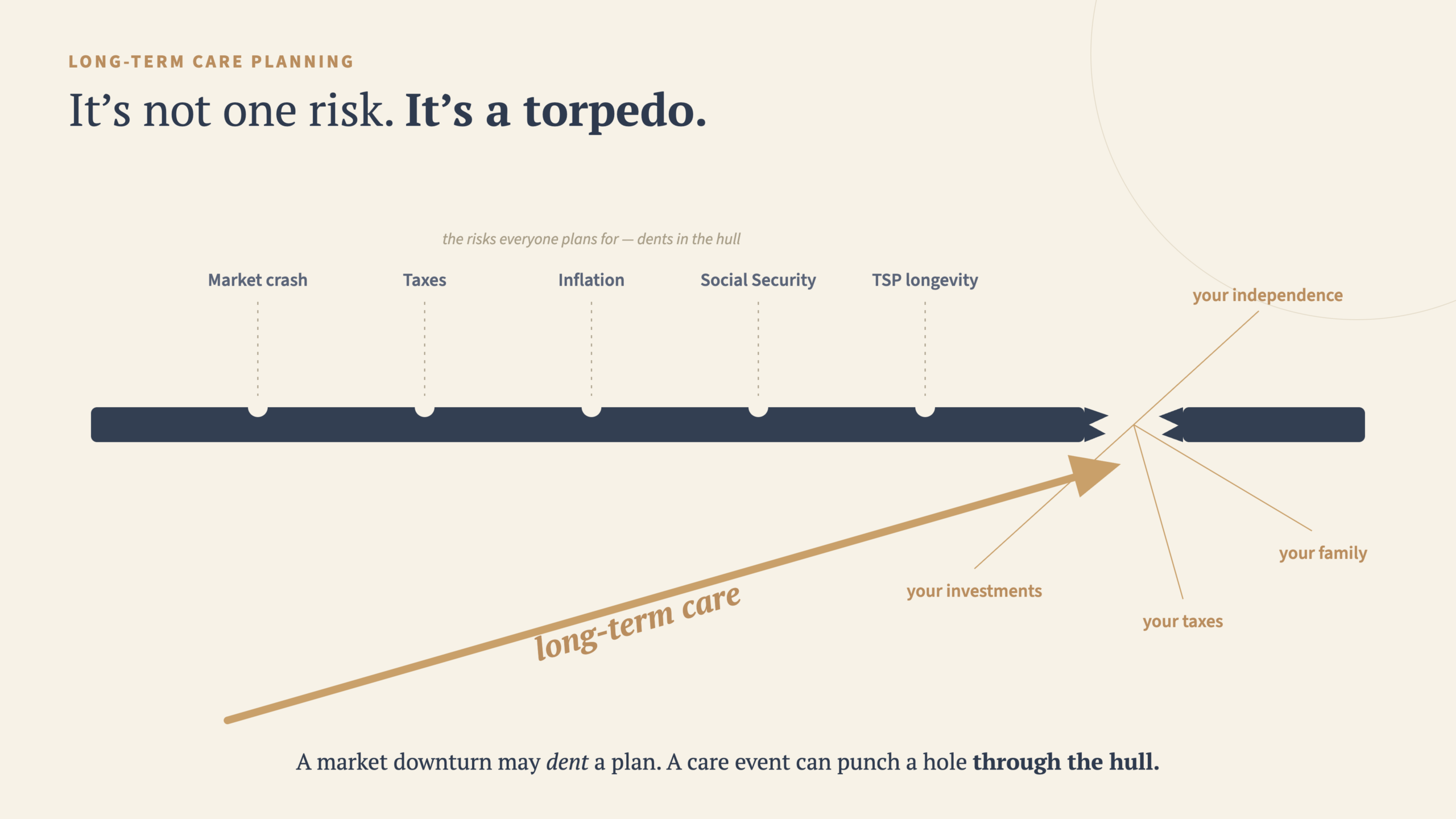
Market crashes. Inflation. Taxes. Social Security. Whether the TSP will last.
Those risks matter. But long-term care is different because it is not just one problem. It is several problems wrapped together.
A long-term care event can create:
- Higher monthly expenses
- Forced withdrawals from investments
- Tax consequences from those withdrawals
- Stress on a spouse or adult children
- Disruption to family relationships
- Loss of independence
- Pressure on the surviving spouse’s financial security
A market downturn may dent a retirement plan. Long-term care can punch a hole through the hull.
And once a crisis begins, families rarely have the luxury of calm, thoughtful planning. Decisions are made under stress, under time pressure, and often with incomplete information.
But before you can plan for it, you first need to understand what long-term care actually means.
What Long-Term Care Really Means
When people hear “long-term care,” they often picture a nursing home. That can be part of it, but long-term care does not always begin there.
Long-term care often starts quietly, with someone needing just a little more help than the family can comfortably provide.
It may include help with:
- Grocery shopping
- Getting dressed
- Bathing
- Cooking
- Transportation
- Medication reminders
- Mobility
- Staying safe at home
It can also include home care, assisted living, memory care, or full nursing care.
The trigger is not always a major health event. Sometimes it is a slow loss of independence. A fall. Cognitive decline. Mobility issues. An old injury getting worse. Or a spouse who used to provide help but can no longer physically do it.
Aging at home requires people, money, backup options, and a realistic understanding of what kind of help may eventually be needed.
The dream is to stay independent. The plan is what protects that independence when life begins to change.
The Health Insurance Trap: Medicare, FEHB, and TRICARE
One of the biggest misconceptions federal retirees have is assuming their health insurance will cover long-term care.
This is where the message needs to be very clear: Medicare is not long-term care insurance. FEHB is not long-term care insurance. TRICARE is not long-term care insurance.
These programs can be extremely valuable for traditional healthcare. But the care that often breaks a retirement plan is not always the care provided by a doctor. It is the care needed after the doctor is gone.
That is generally custodial care, and traditional health insurance is not designed to pay for years of that kind of support.
Medicare may cover skilled nursing facility care for a limited time if specific conditions are met, and that coverage can last up to 100 days in a benefit period. But that is not the same as paying for years of long-term custodial care.
After that limited skilled-care window, if the need is ongoing help with daily living, the bill often becomes your responsibility.
This is the dangerous gap.
Once you understand that gap, the question becomes simple: if health insurance is not the plan, what is?
The Three Ways to Plan for Long-Term Care
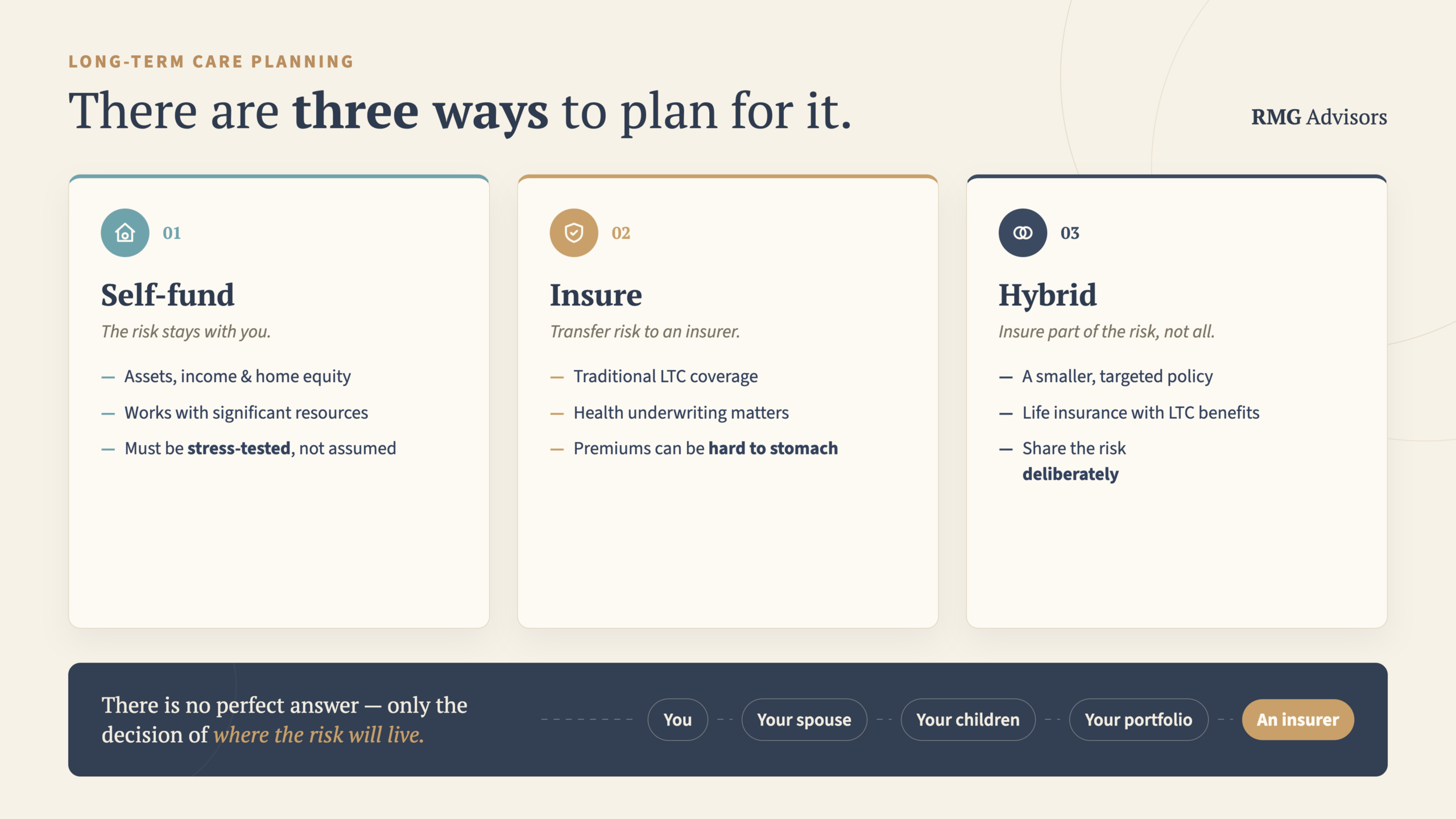
There are three broad ways to plan for long-term care. Each has tradeoffs.
Option 1: Self-Funding Long-Term Care
Self-funding means you use your own assets, income, home equity, or investment accounts if care is needed. This can work for retirees with significant resources, but it needs to be stress-tested.
Saying “I have enough money” is not the same as knowing how a three-year care event would affect your spouse, your taxes, your portfolio, and your lifestyle.
For federal retirees, the pension may cover many basic expenses. But if care costs are layered on top, the additional money often needs to come from somewhere else, such as the TSP, IRA assets, taxable investments, home equity, or other savings.
That can create a chain reaction. A large withdrawal may create taxes. Higher taxable income may affect Medicare premiums. Selling investments during a down market may damage the portfolio. And if one spouse needs care, the healthy spouse still needs enough income and assets to maintain their own life.
The question is not, “Do we have enough money?” The question is, “Can our plan absorb a long-term care event without sacrificing the surviving spouse’s security or creating other tax and financial problems?”
Option 2: Long-Term Care Insurance
The second approach is insurance. Traditional long-term care insurance (like FLTCIP) transfers some of the risk to an insurance company, if you are healthy enough to qualify and if the premiums fit your budget.
Insurance can help protect assets, preserve care options, and reduce the pressure on a spouse or children. But it also comes with challenges.
Coverage can be expensive. Underwriting matters. Premiums may rise. And for some families, traditional long-term care insurance has become harder to justify or harder to afford.
For federal employees and retirees, the Federal Long Term Care Insurance Program (FLTCIP), was once a major planning option for many. If you already have coverage, it is worth reviewing carefully. But for those who did not get in before the program closed to new applicants, that may no longer be available as a new planning option.
Existing coverage should still be reviewed. You want to understand:
- The daily or monthly benefit amount
- The inflation protection
- The elimination period
- The total pool of benefits
- What kind of care is covered
- What triggers a claim
Do not assume a policy solves everything. It may cover part of the risk, not all of it.
Option 3: Hybrid Long-Term Care Planning
The third approach is hybrid planning. This may mean insuring part of the risk, not all of it. It could mean using a smaller policy. It could mean considering hybrid life insurance products with long-term care benefits.
Hybrid policies are not right for everyone, but they can appeal to retirees who dislike the idea of paying traditional long-term care premiums for years and potentially never using the benefit.
Some hybrid policies may have fixed premiums over a set period. For example, premiums might be paid over 10 years, after which the policy is considered “paid up”. If long-term care is needed, the policy may provide benefits. If care is never needed, there may still be a death benefit for heirs.
The tradeoff is that these policies can require higher premiums upfront and need to be evaluated carefully. You also lose the “use” of this capital where you could have invested it yourself during that time. Opportunity cost.
Why “My Family Will Help” Is Not a Plan
A lot of people say, “If something happens, my spouse will help,” or “my kids will take care of me.” And maybe they will.
Family is often part of the solution. But relying entirely on family can create a burden no one fully understands until they are living it. Caregiving can affect careers, marriages, physical health, mental health, finances, and relationships between siblings.
A spouse may desperately want to help but may not be physically able to provide care for years.
Adult children may live far away. They may have jobs, young children, marriages, financial pressures, and limited time. They may also disagree with each other about what should be done.
This is where love and planning are not the same thing. Your kids may love you enough to help. That does not mean you should make them discover the plan during a crisis.
Good planning does not exclude family. It gives family a roadmap. It helps answer:
- What kind of care would you prefer?
- Where would the money come from?
- Who has authority to make decisions?
- What options are realistic?
- How can family help without being forced to sacrifice their own lives?
How to Stress-Test Long-Term Care in a Retirement Plan
Long-term care planning becomes much more practical when you stress-test it. Federal retirees often plan for the things they want: travel, home renovations, hobbies, family gifts, or a more relaxed lifestyle.
Those are important. But what happens if you spend aggressively early in retirement and then need that money later for care?
That does not mean you should avoid enjoying retirement, but it does means the plan should be tested before those decisions are made.
Think of it like financial bloodwork. You are not trying to predict every diagnosis. You are trying to see whether the vital signs of the plan are healthy. Start with a few scenarios:
Scenario 1: Part-Time Care at Home
One spouse needs part-time care at home for two or three years. Where does the money come from? Does it affect travel, gifting, or portfolio withdrawals? Can the healthy spouse maintain their lifestyle?
Scenario 2: Assisted Living or Memory Care
One spouse needs assisted living or memory care for several years. How does that change monthly spending? Does the plan still work if costs rise over time? What assets would need to be used first?
Scenario 3: Full Nursing Care
One spouse needs full nursing care while the other spouse still needs to maintain the home, lifestyle, and income plan.
Can the portfolio support both needs? What happens if markets are down at the same time? What are the tax consequences of withdrawing larger sums?
If the care event leaves the surviving spouse financially vulnerable, the retirement plan was never fully protected.
Long-Term Care and Retirement Income Decisions
Long-term care planning is not separate from retirement income planning.
It directly affects how much you can safely spend, how your assets should be invested, how much cash reserve you may need, and how withdrawals should be coordinated.
If care starts tomorrow, where do the first and last dollars come from?
Do withdrawals come from the TSP? An IRA? A Roth IRA? A taxable account? Home equity?
Each choice can create different tax and investment consequences.
This is why long-term care planning belongs inside the broader retirement income plan. It should not be treated as a separate insurance conversation that happens once and then gets forgotten.
For federal retirees, the FERS pension may provide a strong income foundation but it does not automatically solve long-term care.
Every Passing Year Limits Your Options
Long-term care is a hard topic because it forces us to imagine a version of life none of us wants. But avoiding the conversation does not make the risk disappear.
Planning for long-term care is not about pessimism. It is about preserving dignity, independence, and choice. It is about protecting your spouse and giving your children a roadmap. It is about making sure one care event does not undo decades of disciplined saving and thoughtful retirement planning.
So build the roadmap now while you still have options, because it’s not just your money, it’s your future.